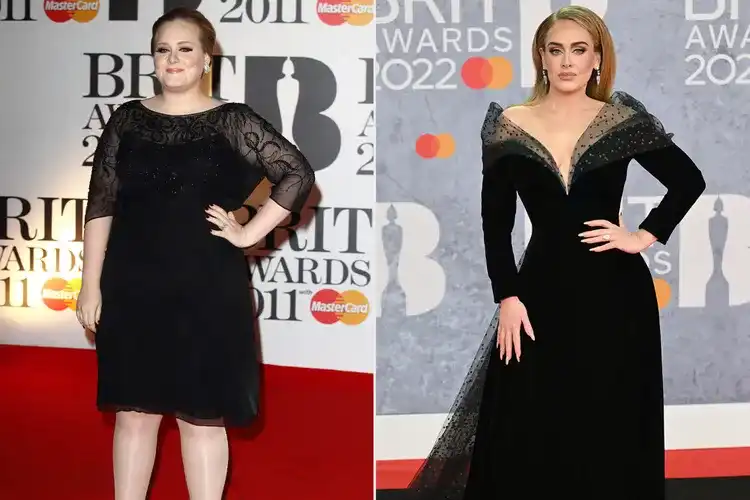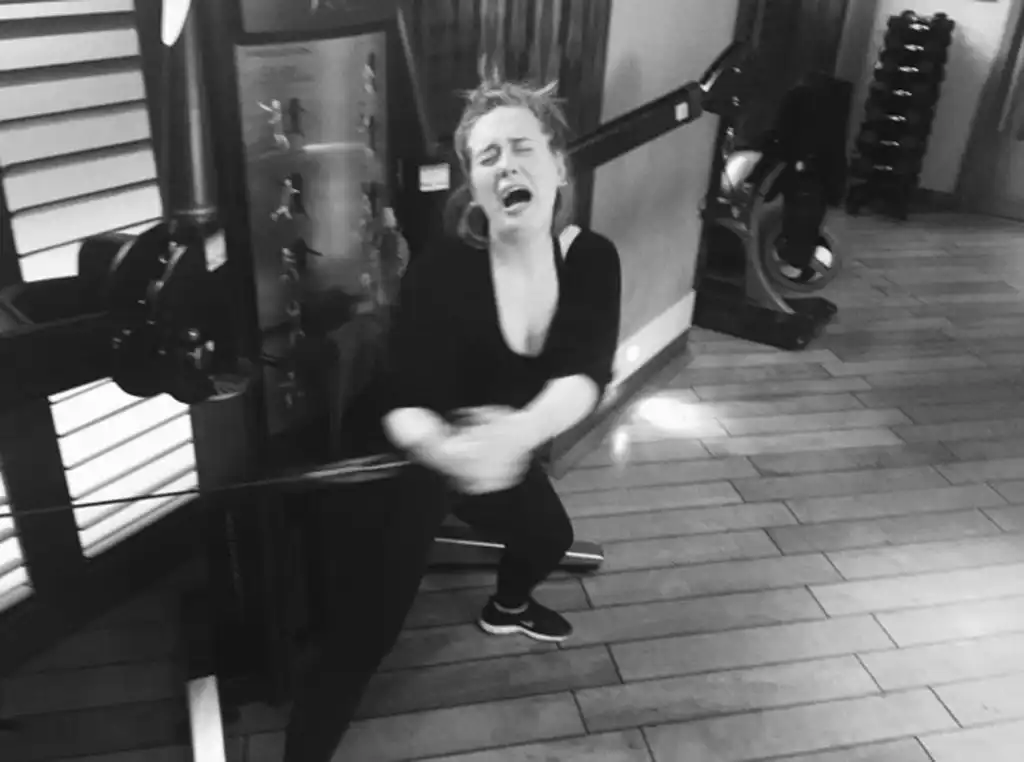
Adele’s workout story is more nuanced than the celebrity “before-and-after” routines that circulate online.
The strongest public evidence shows that Adele has used weight lifting, strength training, circuit-style training, cardio, hiking and boxing, and that exercise became an important part of her life during a difficult period. In a 2021 British Vogue interview, Adele said she sometimes trained two or three times a day during one particularly exercise-focused period, combining weights with hiking or boxing and cardio. She also said the goal was not simply losing weight: exercise helped her manage anxiety and feel physically stronger.
Her trainer Gregg Miele likewise told Vogue that the initial goal was becoming stronger physically and mentally, and that Adele became particularly enthusiastic about strength training.
Pilates and reformer Pilates are part of the public story too, but the evidence needs more qualification. Earlier reports connected Adele with Pilates and reformer classes, while Pilates instructor Camila Goodis said she had trained Adele after the birth of her son. However, Adele later pushed back strongly against people claiming to have trained her and specifically mentioned a Pilates instructor she said she had never met.
That distinction matters. There is no reliably documented complete daily or weekly “Adele workout plan” covering every exercise, set, repetition, weight, session length and training day. Many websites fill those gaps with reconstructed routines that go beyond the evidence.
The most defensible interpretation is that Adele’s fitness routine involved structured resistance training plus cardiovascular and movement-based activities, with Pilates appearing in earlier reporting but not documented clearly enough to describe as the single foundation of her transformation.
Adele’s Workout Routine at a Glance
| Training method | What the evidence shows | Confidence |
|---|---|---|
| Weight lifting / strength training | Adele has directly discussed lifting weights and said strength was a major goal. Her trainer Gregg Miele confirmed her focus on strength training. | Strongly established |
| Cardio | Adele directly described doing cardio and was observed exercising on an elliptical during Vogue‘s 2021 profile. | Strongly established |
| Boxing | Adele has publicly said she boxes and described herself as a good boxer. | Strongly established |
| Hiking | Adele specifically mentioned hiking as part of her exercise routine. | Strongly established |
| Circuit training | Vogue described her training as involving weight lifting and circuit training. | Strongly reported |
| Pilates | Earlier reporting and a former Pilates instructor connected Adele with Pilates, particularly after childbirth. Adele later disputed some Pilates-related trainer claims. | Reported, but qualified |
| Reformer Pilates | 2019 reporting linked Adele with reformer Pilates classes, but this is not sufficiently supported to describe reformer Pilates as a confirmed central component of her later routine. | Reported, not firmly established |
| HIIT | HIIT is frequently attached to Adele’s workout story online, but there is no strong primary evidence establishing a standardized HIIT program performed by Adele. | Not established as a specific protocol |
| Trainer involvement | Adele publicly discussed working with trainers and identified Gregg Miele as someone she had worked with extensively. | Strongly established |
| Exact weekly schedule | No complete, reliable public schedule exists. Adele’s statement about two or three workouts a day referred to a particular period rather than a permanent prescription. | Unknown |
The key point is that these categories should not all be treated equally. Strength training, cardio, boxing and hiking come directly from Adele’s own descriptions. Pilates and reformer Pilates require considerably more caution.
What Is Adele’s Workout Routine?
There is a real Adele workout story, but it is not the same thing as the highly detailed routines found on celebrity-fitness websites.
Adele gave unusually specific information about her exercise habits during her 2021 British Vogue interview. She explained that working out had become a way to cope with anxiety and create personal time. She said she had become very committed to exercise and, during one period, trained two or three times a day. She described doing weights in the morning, hiking or boxing later in the day and cardio at night. She also acknowledged that this level of training was not realistic for most people because she had trainers and unusually flexible circumstances at the time.
That is much stronger evidence than a generic article claiming that Adele followed a particular seven-day workout split.
What Adele herself has confirmed
Adele’s own comments establish several important pieces of her fitness story:
- She lifted weights.
- Strength became a major focus.
- She did cardio.
- She boxed.
- She hiked.
- She worked with trainers.
- She sometimes trained two or three times a day during a particularly intensive period.
- She viewed exercise as a way to become physically and mentally stronger.
- She did not describe weight loss as her original reason for beginning the routine.
She also told Oprah Winfrey that weight lifting had become her favorite form of exercise and that she had progressed substantially in deadlifting. Contemporary reporting on the interview says she reached approximately 160–170 pounds at her peak, having started much lighter.
That is an example of a useful distinction: the lifting number is documented because Adele herself discussed it; a website inventing the rest of her strength-training program would not have the same evidentiary basis.
What comes from her trainer
Gregg Miele, whom Adele identified as one of the trainers she worked with, told Vogue that the objective was becoming stronger physically and mentally. He said Adele became especially enthusiastic about movement and strength training.
The Vogue profile also placed Adele at the Heart & Hustle gym in West Hollywood with Miele and described her performing an elliptical workout and moving through weight machines.
What comes from earlier reporting
Earlier coverage connected Adele with Pilates, personal training, cardio and circuit training. In 2019, Us Weekly reported that a source described sessions involving cardio, circuit training and Pilates. Another report connected Adele with reformer Pilates classes alongside her friend Ayda Field.
These reports are useful historical evidence, but they should not be treated as equivalent to Adele personally describing her routine.
What remains speculation
The following are not reliably established:
- A permanent seven-day workout schedule
- A specific number of workouts per week
- Exact session durations
- Exact sets and repetitions
- Her complete exercise list
- Her usual lifting weights
- Her precise HIIT intervals
- Her calorie expenditure
- Her heart-rate targets
- A private trainer’s complete programming
- A current routine that can be assumed to remain unchanged
That is why an “Adele workout routine” found online should be read as a reconstruction unless each component can be traced to a credible source.
Did Adele Really Do Pilates?
The answer is yes in the sense that Pilates has been credibly reported as part of her earlier fitness story, but the details are more complicated than the internet usually suggests.
In early 2020, Pilates instructor Camila Goodis told Us Weekly that she had trained Adele after Adele had given birth to her son. Goodis said the sessions were relatively gentle and focused on areas including the core, lower back and pelvic floor. She described Pilates as appropriate for that stage because it could be adapted to different levels of difficulty.
There was also 2019 reporting that linked Adele to Pilates classes and, more specifically, reformer Pilates. Us Weekly reported that Adele was taking reformer classes with Ayda Field, while noting that the report originated with The Sun and that Adele’s representatives had not responded at the time.
But there is an important later qualification.
During her 2021 British Vogue interview, Adele said that many stories about people claiming to have trained her were false. She specifically referenced “some Pilates lady” whom she said she had never met.
That means the responsible conclusion is not that every Pilates-related report about Adele was false. Rather, the public record contains conflicting accounts about who trained Adele and how extensively Pilates featured in her routine.
It is therefore safer to say:
Adele has been publicly associated with Pilates, including earlier reports of reformer Pilates, but Pilates should not be presented as the proven explanation for her fitness transformation or as the unquestioned centerpiece of her later training.

Why Pilates became so prominent in the Adele workout story
Pilates makes an appealing celebrity-fitness headline because it sits at the intersection of core strength, controlled movement, mobility and muscular endurance.
General research supports several physical benefits of Pilates. Systematic reviews have found evidence for improvements in areas such as flexibility, dynamic balance and muscular endurance, although the strength and quality of evidence vary by population and outcome.
Mayo Clinic describes Pilates as a system emphasizing controlled movement and core strength, with mat and equipment-based variations.
But those findings tell us something about Pilates in general, not about what happened inside Adele’s body.
Pilates may help someone develop strength, stability, mobility or muscular endurance. That does not prove Pilates caused Adele’s weight loss or changed her body in any particular way.
Adele and Reformer Pilates
Reformer Pilates is different from traditional mat Pilates because it uses a specialized machine with a moving carriage, springs, straps, ropes and a footbar. The springs provide adjustable resistance and can also provide assistance during certain movements.
That makes reformer work highly adaptable. Depending on the programming, a session can emphasize core control, strength, balance, coordination, flexibility or muscular endurance.
Mayo Clinic also describes reformer classes as machine-based Pilates using adjustable straps and pulleys.
So, did Adele use a reformer?
There is historical reporting that says she did.
In 2019, Us Weekly reported that Adele was taking reformer Pilates classes with Ayda Field. The same report emphasized that the claim came from The Sun and that Adele’s representative had not responded.
Other contemporary coverage repeated the reformer-Pilates claim.
However, Adele’s later comments about false trainer claims make it inappropriate to upgrade that reporting into an absolute statement such as “Adele’s transformation was built around reformer Pilates.”
The best wording is “Adele was reported to have used reformer Pilates” rather than “Adele’s workout was reformer Pilates.”
That distinction is especially important because general reformer-Pilates benefits such as improved core strength, flexibility, balance and muscular endurance cannot be used as proof that reformer Pilates produced Adele’s individual results.
Adele’s Strength Training and Weight Lifting
This is the strongest part of the Adele workout evidence.
Unlike some of the Pilates stories, Adele herself has repeatedly discussed strength training.
In British Vogue, she said that her workouts included weights and described becoming physically stronger as a central objective. Her trainer Gregg Miele independently confirmed that strength training became a major focus.
Adele later told Oprah Winfrey that she had become particularly interested in deadlifting. Reporting from the interview documented her statement that she had reached approximately 160–170 pounds at her peak, after starting with a much lighter load.
That makes Adele weight lifting and Adele strength training among the most firmly supported search topics in this article.
What resistance training can do generally
Resistance training includes far more than traditional barbell lifting. It can involve free weights, machines, resistance bands, bodyweight exercises and other forms of external resistance.
Its established role in fitness includes:
- improving muscular strength
- supporting muscle mass and lean tissue
- improving functional capacity
- contributing to healthy body composition
- providing mechanical stimulus important for bone health
- complementing cardiovascular training
Research supports the broader value of resistance exercise. A systematic review and meta-analysis in healthy adults found that resistance training can improve body-composition measures, while other research supports its role in maintaining or improving lean mass.
Resistance training is also relevant to bone health, particularly as people age. Systematic reviews have found positive effects on bone mineral density in some populations, although results vary by age, training design and skeletal site.
The World Health Organization recommends that adults include muscle-strengthening activities involving the major muscle groups on at least two days per week as part of an overall physical-activity pattern.
None of that means Adele gained a particular amount of muscle because of weight lifting. Nor does it prove that her deadlifting performance caused her weight loss.
It simply explains why strength training can be an important component of a balanced fitness program.
Adele’s strength-training goal was broader than appearance
One of the most revealing parts of Adele’s story is how she described the psychological role of training.
She said that when she worked out, she experienced less anxiety and that exercise was about becoming stronger rather than simply getting smaller. Miele described the goal similarly.
Adele also told The Face that developing her core strength made her feel more capable of moving around and participating in everyday activities.
That is a more useful interpretation of her weight-training story than the idea that lifting weights was simply a method for “burning fat.”
Did Adele Do Cardio or HIIT?
Adele and cardio
Cardiovascular exercise is clearly part of Adele’s documented routine.
She directly told British Vogue that she did cardio, and the profile’s reporter observed her exercising on an elliptical at Heart & Hustle. Adele also described hiking and boxing as activities she incorporated into her routine.
So Adele cardio is a well-supported search topic.
What is not established is the exact form, duration or intensity of every cardio session.
Adele’s description does not tell us whether her cardio was always steady-state, interval-based, machine-based or something else.
What is HIIT?
High-intensity interval training, or HIIT, generally involves repeated bouts of relatively intense exercise separated by periods of recovery. A 2024 umbrella review described HIIT in those terms and found that HIIT can improve cardiorespiratory fitness in adults.
That is different from simply saying “cardio.”
A brisk walk, continuous cycling session or conventional elliptical workout can be cardiovascular exercise without being HIIT. HIIT requires an interval structure involving repeated higher-intensity efforts and recovery periods.
Did Adele specifically do HIIT?
This is where online coverage often becomes too confident.
There is plenty of celebrity-fitness content that labels Adele’s training “HIIT,” “high-intensity workouts” or similar terms. But there is not enough strong primary evidence to establish a standardized Adele HIIT protocol.
Adele has discussed weights, circuit training, boxing, hiking and cardio. Those activities can potentially be incorporated into many kinds of training programs, but they do not automatically equal HIIT.
So this article should not claim that Adele performed:
- a particular work-to-rest ratio
- a specific HIIT circuit
- a particular number of intervals
- a particular number of HIIT sessions per week
- a specific heart-rate zone
- a specific calorie expenditure
Unless Adele or a credible trainer documents those details, they remain unknown.
This is particularly important because “HIIT” is frequently used loosely online. A celebrity article calling a workout “HIIT” does not necessarily mean the session followed a standardized exercise-science protocol.
How Did Exercise Fit Into Adele’s Transformation?
The most accurate way to understand Adele’s fitness transformation is to see exercise as one part of a broader change in her life, rather than as a single magic workout.
Adele has said that she began relying on exercise during a period when she was experiencing significant anxiety. She described the gym as a place where she could focus, feel calmer and spend time without her phone.
She later described the physical benefits of becoming stronger and more mobile.
Her public comments also make clear that the weight change occurred over an extended period rather than overnight. In British Vogue, she described the transformation as taking place over roughly two years.
That context matters because exercise and body weight are not related in a simple one-exercise-equals-one-result equation.
Physical activity affects fitness, energy expenditure, muscle, cardiovascular capacity, movement and overall health. Nutrition, sleep, stress, daily activity, genetics, environment and individual physiology can also influence body weight and body composition.
For a broader overview of the transformation, see Adele’s broader weight-loss transformation.
The important point for this article is that there is no evidence that one Adele workout caused her transformation.
Adele’s Trainer and Fitness Support
Trainer involvement is one of the better-supported elements of Adele’s fitness story.
Adele told Vogue that she had spent substantial time working with Gregg Miele and was frustrated by people who claimed they had trained her when she had never met them. The Vogue profile also documented Miele leading a workout with Adele at Heart & Hustle.
Miele subsequently told Vogue that Adele’s initial objective was becoming stronger physically and mentally and that she became particularly interested in strength training.
This is much stronger evidence than naming every trainer who has ever appeared in a story about Adele.
Why celebrity training is different
A celebrity fitness routine can be difficult to compare with ordinary exercise because the surrounding circumstances may be very different.
A professional athlete, performer or celebrity may have access to:
- personal trainers
- specialized facilities
- individualized programming
- exercise equipment
- flexible scheduling
- coaching support
- recovery resources
- multiple training environments
Adele herself acknowledged this difference. When discussing the period in which she was training multiple times a day, she noted that she had trainers and that the routine was not realistic for many people.
That admission is worth paying attention to. The useful lesson is not “train three times a day.” It is that her routine was built around circumstances that many readers do not share.
Adele Workout Plan: Is There a Real One?
Searches for an Adele workout plan often produce neat weekly schedules that look authoritative.
They should be treated cautiously.
There is a difference between:
- Adele’s reported workouts Activities she personally described or that credible reporting directly observed.
- Trainer-reported information Statements from trainers with a demonstrable connection to Adele.
- Generic Pilates workouts Exercises that belong to the Pilates method but are not necessarily exercises Adele performed.
- Generic strength programs Standard resistance-training routines created for the general public.
- Generic HIIT workouts Interval workouts that have nothing specifically to do with Adele.
- Media-created celebrity workout plans Routines reconstructed from scattered information.
- Fan-created routines Programs based largely on speculation.
The last four categories should not be presented as Adele’s actual workout.
A responsible article can explain the exercise methods associated with Adele without pretending to know her private programming.
Why there is no reliable seven-day Adele plan
Adele has publicly described different periods of training, and the available evidence comes from interviews and reporting rather than a published training log.
Even her statement that she worked out two or three times a day describes a particular period. It does not establish that she permanently followed that schedule.
There is also no reliable public record documenting every exercise, set, repetition and training load across a week.
So a seven-day “Adele workout plan” may be useful as a generic celebrity-inspired fitness program, but it should never be labeled Adele’s actual routine without evidence.
What We Know vs. What We Don’t Know
| What We Know | What We Don’t Know |
|---|---|
| Adele has directly discussed weight lifting and strength training. | Her complete strength-training program. |
| She has said she did cardio. | Her exact cardio exercises, duration or intensity. |
| She has said she hiked and boxed. | How frequently she performed either activity across a normal week. |
| Adele worked with trainer Gregg Miele. | Every trainer or coach involved at every stage of her life. |
| Miele confirmed strength training was an important part of her approach. | Miele’s private programming details. |
| Adele said she sometimes trained two or three times a day during a particular period. | A permanent weekly frequency. |
| She has discussed deadlifting and reported reaching about 160–170 pounds at her peak. | Her current lifting numbers or ongoing strength level. |
| Earlier reporting connected her with Pilates. | How much Pilates contributed to her later routine. |
| Earlier reports linked her with reformer Pilates. | Whether reformer Pilates remained a central part of her later training. |
| Adele later disputed some Pilates-trainer claims. | Which specific historical Pilates reports she considered inaccurate. |
| She has been observed doing cardio and gym-based resistance work. | A complete list of exercises she performed. |
| Exercise was important to her mental wellbeing and sense of strength. | The precise contribution of exercise to her weight change. |
| Her transformation occurred over an extended period. | A scientifically measured breakdown of fat loss, muscle gain or other body-composition changes. |
| Public reporting supports a mixed approach to exercise. | A verified “secret workout” responsible for her transformation. |
The strongest evidence is therefore concentrated around strength training, cardio, boxing, hiking and trainer-supported exercise.
Pilates belongs in the story, but with a lower level of certainty.
Can Adele’s Workout Explain Her Weight Loss?
Not by itself.
Exercise can contribute to changes in body weight and body composition, but it is scientifically inappropriate to attribute an individual’s entire transformation to one training method without detailed evidence.
Adele herself did not describe exercise as a weight-loss prescription. In British Vogue, she said working out was about becoming stronger and managing anxiety. Her trainer similarly described the goal as physical and mental strength rather than weight loss.
That distinction is important.
Exercise affects more than body weight
A balanced exercise program can improve:
- muscular strength
- cardiovascular fitness
- physical capacity
- mobility
- coordination
- functional performance
- bone health
- body composition
- mental wellbeing
- sleep and other aspects of health
The WHO recommends combining aerobic physical activity with muscle-strengthening activity because the two forms of training provide overlapping but distinct health benefits.
Resistance training research also shows benefits for lean mass and body composition, while aerobic exercise supports cardiorespiratory fitness.
But none of those findings allow researchers to calculate how much of Adele’s personal weight change came from weights, cardio, boxing, Pilates or any other activity.
Avoid the “fat-burning exercise” trap
It is tempting to say that a particular workout “burned Adele’s fat,” but that oversimplifies how body composition changes.
There is no credible evidence that Pilates alone, weight lifting alone or HIIT alone caused Adele’s transformation.
Her own account points instead toward a sustained period of increased physical activity and structured training, alongside the many other factors involved in a person’s life.
Readers interested in the nutrition side of the story can separately explore Adele’s reported diet and Sirtfood connection.
What Adele Has Said About Exercise and Fitness
Adele’s own comments are especially valuable because they provide context that is often lost when her workout is reduced to a list of exercises.
Exercise was initially about feeling stronger
Adele told Vogue that exercise was never primarily about losing weight. She described becoming physically stronger as a way of working toward emotional and mental strength.
The gym helped her manage anxiety
She said that when she worked out, she did not experience the same anxiety and that the gym became personal time for her.
She used multiple forms of exercise
Her description included weights, hiking, boxing and cardio.
She enjoyed strength training
During her Oprah interview, Adele said weight lifting had become her favorite exercise and discussed her progress with deadlifting.
She did not present her routine as universally attainable
Adele acknowledged that her particularly intensive period of training was not doable for many people because she had trainers and unusual circumstances.
That may be one of the most useful statements in the entire Adele workout story.
Should You Copy Adele’s Workout?
No not literally.
Celebrity workout routines are individual programs, not universal prescriptions.
Adele’s training took place with professional support and within circumstances that are not representative of most people’s lives. She also had a particular set of goals, preferences, training experience and circumstances.
Someone beginning exercise should not assume that a routine performed by an experienced celebrity is automatically appropriate for them.
Consider your own starting point
A sensible exercise program should reflect:
- current fitness level
- training experience
- personal goals
- available time
- preferred activities
- recovery capacity
- physical limitations
- age
- access to equipment
- enjoyment and motivation
A beginner does not need to reproduce an advanced lifter’s routine to benefit from strength training.
Likewise, someone who dislikes running can improve cardiovascular fitness through another suitable aerobic activity.
What about injuries or physical limitations?
Adele’s publicly discussed physical history should not be used to diagnose or prescribe exercise for anyone else.
If you have an injury, persistent pain, a medical condition or another limitation that affects exercise, appropriate professional guidance is more useful than copying a celebrity routine.
The goal is not to train as hard as possible.
The goal is to train appropriately and consistently.
What Can Readers Actually Learn From Adele’s Fitness Routine?
The most useful lessons from the Adele workout story are not her celebrity-specific exercises. They are the broader principles behind a balanced fitness approach.
1. Consistency matters more than novelty
Adele’s public account describes exercise becoming a regular part of her life over an extended period. The lesson for ordinary exercisers is not to replicate her volume, but to find an activity pattern that can realistically be maintained.
2. Strength training deserves a place in fitness
Adele’s enthusiasm for weight lifting illustrates that resistance training does not have to be viewed solely as a bodybuilding activity.
It can support strength, functional fitness, lean mass and bone health.
3. Cardiovascular exercise complements resistance training
Strength and cardio serve different purposes.
Cardiovascular training challenges the cardiorespiratory system, while resistance training provides a direct stimulus for muscular strength and adaptation.
The WHO recommends both aerobic activity and muscle-strengthening activity for adults.
4. Mobility and controlled movement matter too
Pilates can be one option for people who enjoy controlled movement and want to work on core strength, balance, mobility and muscular endurance. Research supports some of these benefits, although the evidence varies depending on the outcome being studied.
That is a general lesson not proof that Pilates caused Adele’s transformation.
5. Recovery is part of training
A sustainable exercise routine also needs recovery.
More exercise is not automatically better exercise. Training volume should be appropriate to the individual, and adequate sleep, nutrition and rest all contribute to the ability to train consistently.
Adele’s unusually intensive exercise period should therefore not be interpreted as an instruction to exercise multiple times every day.
6. Enjoyment can improve adherence
Adele has spoken enthusiastically about lifting weights and boxing.
That suggests a useful principle: the best exercise is often the type you are willing to keep doing.
A technically perfect routine that you hate may be less useful in the long term than a balanced program built around activities you genuinely enjoy.
7. Exercise goals do not have to revolve around weight
This may be the most important lesson.
Adele repeatedly framed exercise around mental wellbeing, strength and feeling better rather than simply becoming thinner.
Fitness can be measured in many ways:
- lifting more comfortably
- walking farther
- improving cardiovascular capacity
- moving with greater confidence
- developing better balance
- gaining strength
- improving mobility
- sleeping better
- enjoying physical activity
- feeling more capable in everyday life
Weight is only one possible outcome and not necessarily the most meaningful one.
FAQs
What workout did Adele do?
Adele has publicly described weight lifting, strength training, cardio, hiking and boxing. She also worked with trainers. Earlier reporting connected her with Pilates and reformer Pilates, although those claims are less firmly established than her strength and cardio training.
Did Adele really do Pilates?
Pilates was part of earlier reporting about Adele, including comments from a Pilates instructor who said she had trained Adele after childbirth. However, Adele later disputed some claims made by people presenting themselves as her trainers, so Pilates should be described as reported rather than as the unquestioned foundation of her later routine.
Did Adele use reformer Pilates?
Earlier 2019 reports linked Adele with reformer Pilates classes, including classes with Ayda Field. Because Adele later disputed some Pilates-related trainer claims, reformer Pilates is best described as historically reported, not as a definitively documented centerpiece of her later workout program.
Did Adele lift weights?
Yes. This is one of the best-established parts of the Adele workout story. She has repeatedly discussed weight lifting and strength training and told Oprah Winfrey about her deadlifting progress.
Did Adele do HIIT?
There is not enough strong primary evidence to say that Adele followed a standardized HIIT program. She has described cardio, boxing and circuit-style training, but those should not automatically be relabeled as HIIT.
How often did Adele work out?
During one particularly intensive period, Adele said she worked out two or three times a day. She also explained that she had trainers and that this routine was not realistic for many people. That statement should not be interpreted as a permanent weekly schedule.
Who was Adele’s trainer?
Gregg Miele is one of the trainers most clearly connected to Adele through her own public comments and Vogue reporting. Adele said she had spent significant time working with him, and Miele discussed her strength-training goals with Vogue.
What is Adele’s workout plan?
There is no complete, verified public Adele workout plan that documents every training day, exercise, set, repetition, weight and session duration. Online seven-day plans should therefore be treated as reconstructions or generic celebrity-inspired programs unless independently sourced.
Did exercise cause Adele’s weight loss?
Exercise was clearly part of Adele’s lifestyle transformation, but there is no evidence that one exercise modality caused her weight loss. Adele herself said her initial motivation was mental wellbeing and becoming stronger rather than losing weight.
Can I safely follow Adele’s workout?
You should not copy Adele’s routine literally. Her training involved professional trainers and circumstances that are not typical. A suitable program should be adapted to your fitness level, experience, goals, recovery needs and any physical limitations.
Final Takeaway
The most responsible interpretation of the Adele workout story is not that she discovered one secret exercise routine.
Adele has clearly and repeatedly spoken about weight lifting, strength training, cardio, boxing and hiking, and her trainer Gregg Miele has confirmed that strength became a major focus of her training.
Pilates and reformer Pilates have also appeared in credible historical reporting, including reports that connected her with Pilates after childbirth and with reformer classes. But Adele later disputed some claims from people presenting themselves as her trainers, which means those elements deserve more cautious wording.
There is also no reliable evidence for a standardized Adele HIIT program, despite the term appearing frequently in online celebrity-workout coverage.
Most importantly, no single form of exercise should be presented as the proven cause of Adele’s transformation. Her own account emphasizes strength, movement, mental wellbeing and consistency rather than a “fat-burning” secret.
The useful lesson is therefore broader: combine resistance training and cardiovascular activity in ways that suit your own circumstances, include mobility and recovery, choose activities you enjoy, and measure fitness by more than body weight.
Adele’s routine was personal, professionally supported and shaped by circumstances that many people do not share. The goal for an ordinary exerciser should not be to recreate a celebrity’s private schedule, but to build a sustainable fitness routine that works for their own life.